Empirical Rule Calculation
Find the Empirical rule for the given set of data using this calculator.
Calculator
Empirical rule is the statistical rule for a normal distribution determined with the mean and the standard deviation.
According to it, 68 % of data falls within first SD, 95 % within first two SD and 99.7 % within first three SD's.
Hence it is also known as 68-95-99.7 or three sigma rule.
The empirical rule works because it allows to estimate probabilities very quickly when someone dealing with a normal distribution.
We often create ranges using standard deviation, so knowing what percentage of cases fall within 1, 2 and 3 standard deviations can be useful.
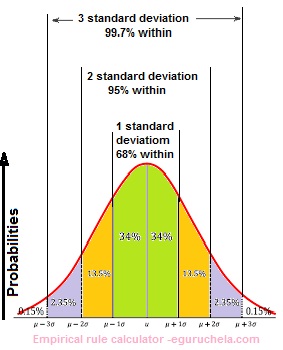
The empirical rule referred as three-sigma rule or 68-95-99.7 rule, it is a statistical rule which states that for a normal distribution, almost all observed data will fall within three standard deviations (denoted by σ) of the mean or average (denoted by µ).
The empirical value is :
a. derived from or relating to experiment and observation rather than theory,
b. based on practical experience rather than scientific proof and
c. (Philosophy) a (of knowledge) derived from experience rather than by logic from first principles.
Empirical means “based on observation” : The empirical rule come from observations. The Normal/Gaussian distribution is the most common type of data distribution. All of the measurements are computed as distances from the mean and are reported in standard deviations.
Frequently Asked Questions
What is the Empirical Rule?
The Empirical Rule states that approximately 68%, 95%, and 99.7% of observations in a normal distribution fall within one, two, and three standard deviations from the mean respectively.
Why is it called the 68-95-99.7 Rule?
The name comes from the percentages of observations expected within one, two, and three standard deviations of the mean.
Does the Empirical Rule apply to every dataset?
No. It is most accurate for data that follows an approximately normal or bell-shaped distribution.
What is a normal distribution?
A normal distribution is a symmetrical probability distribution where most observations cluster around the mean.
How do I find standard deviation?
Standard deviation is calculated as the square root of variance and measures how spread out data values are from the mean.
Can the Empirical Rule identify outliers?
Yes. Values beyond three standard deviations from the mean are often considered unusual or potential outliers.
What is the difference between the Empirical Rule and Chebyshev's Theorem?
The Empirical Rule applies specifically to normal distributions, while Chebyshev's Theorem applies to all distributions regardless of shape.
Why is standard deviation important?
Standard deviation measures variability and helps determine how concentrated or dispersed data values are around the mean.
Can I use decimal numbers in this calculator?
Yes. The calculator accepts both integer and decimal values.
What industries use the Empirical Rule?
Statistics, manufacturing, engineering, healthcare, education, economics, finance, and scientific research commonly use the Empirical Rule.