Beats
When two sound waves of different frequency approach your ear, the alternating constructive and destructive interference causes the sound to be alternatively soft and loud - a phenomenon which is called "beating" or producing beats.
A beat is an interference pattern between two sounds of slightly different frequencies, perceived as a periodic variation in volume whose rate is the difference of the two frequencies.
Beat Frequency
Consider two sound waves having frequencies ω1 and ω2.Then the beat frequency will be ω1 - ω2.
- The wave of frequency is denoted by ω
- Also ω = 2πν
- Therefore νbeat = ν1 – ν2
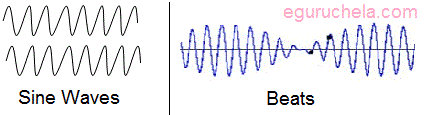
Mathematically beats can be understood from a mathematical identity for sine waves. For sounds with (angular) frequencies of w1 and w2 added together the identity gives
sin(w1t) + sin(w2t) = 2 sin(w3t)cos( w4t)
where w3 is the average of w1 and w2
and w4 is one half of their difference.
If the difference frequency is small, the sound is the sound of a single tone at the average frequency, but with a volume which varies in time at the difference frequency.
This is illustrated on the graphic to the right. The sum is a sine wave with a variable amplitude and the pattern repeats every 0.05s.
That is, there are 1/0.05 = 20 repeats per second.
Examples of Beats
Example 1: If two tuning forks produce frequencies of 256 Hz and 260 Hz, then
Beat frequency = 260 − 256 = 4 beats per second.
This means the sound becomes loud and soft 4 times every second.
Frequently Asked Questions
What are beats in physics?
Beats are periodic variations in loudness produced due to interference between two sound waves of slightly different frequencies.
What is beat frequency?
Beat frequency is the difference between the frequencies of two interfering sound waves.
What is the formula for beat frequency?
νbeat = |ν1 − ν2|
Where are beats used?
Beats are used in tuning musical instruments and detecting small differences in frequencies.