Average Velocity and Average Speed
When we travel from one place to another, our speed is not always constant. Sometimes we move faster, sometimes slower, and sometimes we stop completely. Average speed and average velocity help us describe the overall motion during the entire journey. Distance and displacement have different meanings, so speed and velocity are also different.
The moving car follows a curved road from point A to point B. The curved path represents distance, while the straight line joining the starting and ending points represents displacement.
A fast-moving object has a high speed and covers a relatively large distance in a short amount of time.
A slow-moving object has a low speed and covers a smaller distance in the same amount of time.
An object with no movement has zero speed. Speed is a scalar quantity because it has magnitude only and no direction.
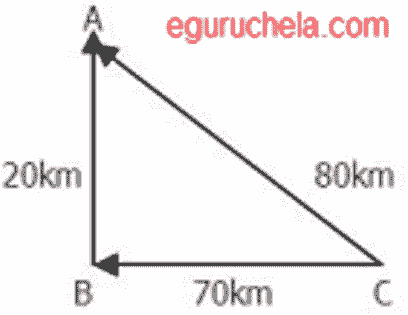
- If an object first moves 70 km to reach point B and then moves 20 km to reach point C, the displacement (AC) is 80 km.
- If the average speed is 40 km/h and the total distance covered is 90 km, then:
- Time taken = 90 ÷ 40 = 2.25 hours
- Average velocity = displacement ÷ time
Formula
Average Velocity = Displacement ÷ Time
= 80 km ÷ 2.25 hr
= 35.5 km/h
Calculating Average Speed and Average Velocity
To calculate average speed and average velocity, we need to know:
- Total distance travelled
- Total displacement
- Total time taken
Average Speed = Total Distance Travelled ÷ Total Time
Average Velocity = Displacement ÷ Total Time
Example
A person drives a bike for 200 km in 5 hours. Find the average speed.
Average Speed = Distance ÷ Time
= 200 km ÷ 5 hr
= 40 km/hr
Similarities Between Average Speed and Average Velocity
Both are calculated by dividing length by time. Both have the same SI unit, which is metre per second (m/s).
Average Velocity Definition
Average velocity is the total displacement divided by the total time taken. It is a vector quantity because it includes both magnitude and direction.
Average Speed Definition
Average speed is the total distance travelled divided by the total time taken. It is a scalar quantity because it has magnitude only.
Difference Between Average Speed and Average Velocity
| Average Speed | Average Velocity |
|---|---|
| Scalar quantity | Vector quantity |
| Depends on total distance | Depends on displacement |
| No direction | Has direction |
| Always positive | Can be positive, negative, or zero |
1. Average speed depends on the total distance travelled.
2. Average velocity depends on displacement between two points.