The Black Hole
Black holes are among the most mysterious and fascinating objects in the universe
A Black Hole is a region in the space where gravity becomes so strong that nothing can escape from it(not even light). This extreme gravitational pull occurs due to large amount of matter has been compressed into a very small space. The boundary surrounding a black hole is called the Event Horizon, which represents the point beyond which escape is impossible.
At the center of a black hole lies a point called a Singularity, where matter is thought to be infinitely dense and all physics laws fails. Black holes are predicted by Albert Einstein's theory of General Relativity.
The black holes are not empty spaces; instead, they contain enormous mass packed into a very tiny region and formed when massive stars collapse at the end of their life cycles or through any other cosmic processes.
Types of Black Holes
The black holes are classified into several categories based on their mass and formation process.
1. Stellar Black Holes
A stellar black hole forms when a massive star collapses after exhausting its nuclear fuel. During a powerful stellar explosion called a Supernova, the core of the star collapses under its own gravity, creating a black hole.
Characteristics
Mass: about 3–20 times the mass of the Sun
Formed from dying massive stars
Most common type of black hole
Example
Cygnus X‑1 : One of the first strong black hole candidates discovered in the Milky Way.
2. Supermassive Black Holes
Supermassive black holes are extremely large black holes found at the centers of most galaxies. They contain millions or even billions of times the mass of the Sun.
Characteristics
Mass: millions to billions of solar masses
Located at the centers of galaxies
Influence the motion of stars and gas around them
Examples
Sagittarius A* : The supermassive black hole at the center of the Milky Way.
M87* : The first black hole ever imaged by the Event Horizon Telescope Collaboration in 2019.
3. Intermediate Black Holes
These black holes fall between stellar and supermassive black holes in terms of size.
Characteristics
Mass: 100–100,000 times the mass of the Sun
Possibly formed by the merging of several stellar black holes or dense star clusters
Rare and harder to detect
Example
HLX‑1 – considered one of the best candidates for an intermediate-mass black hole.
4. Primordial Black Holes (Hypothetical)
Primordial black holes are theoretical black holes believed to have formed shortly after the Big Bang due to extremely dense regions in the early universe.
Characteristics
Could range from microscopic size to large masses
Formed from density fluctuations in the early universe
Not yet confirmed observationally
Example
Scientists continue to search for evidence of primordial black holes through gravitational effects and radiation signals.
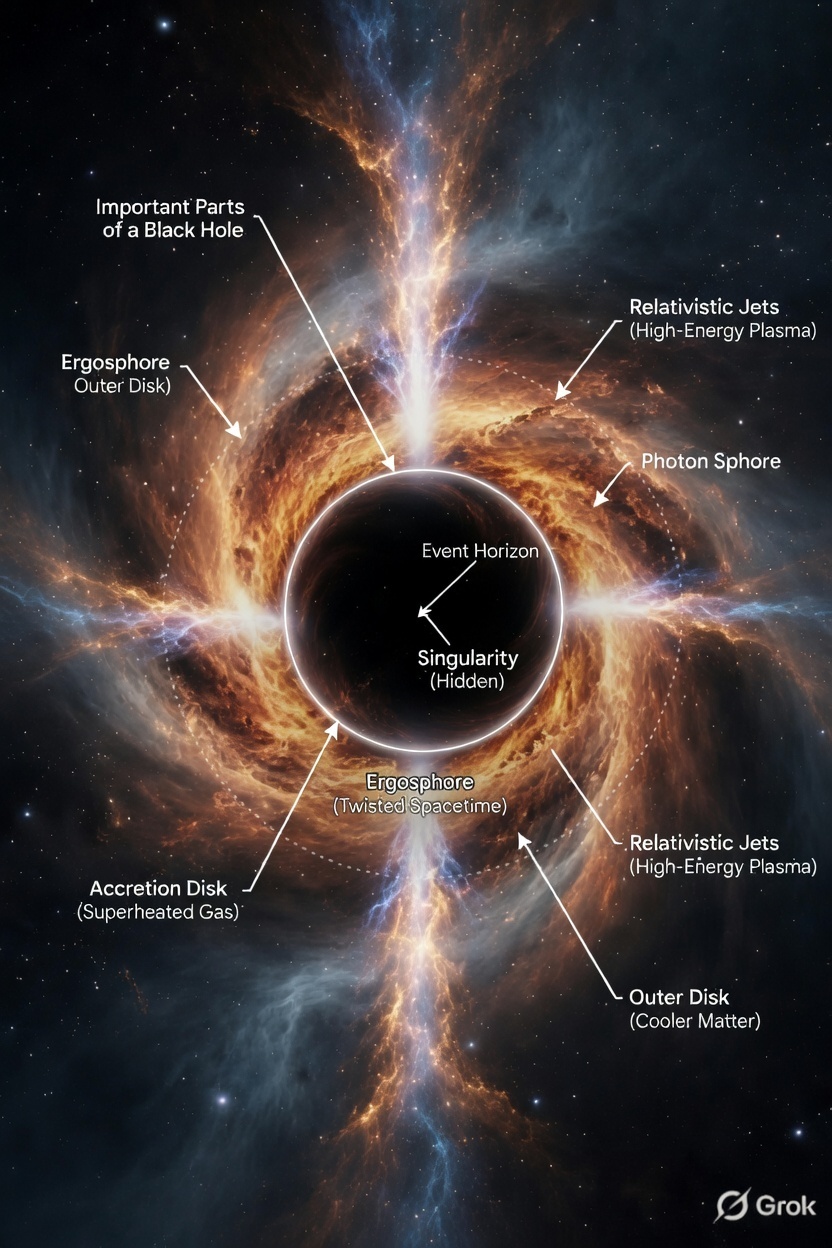
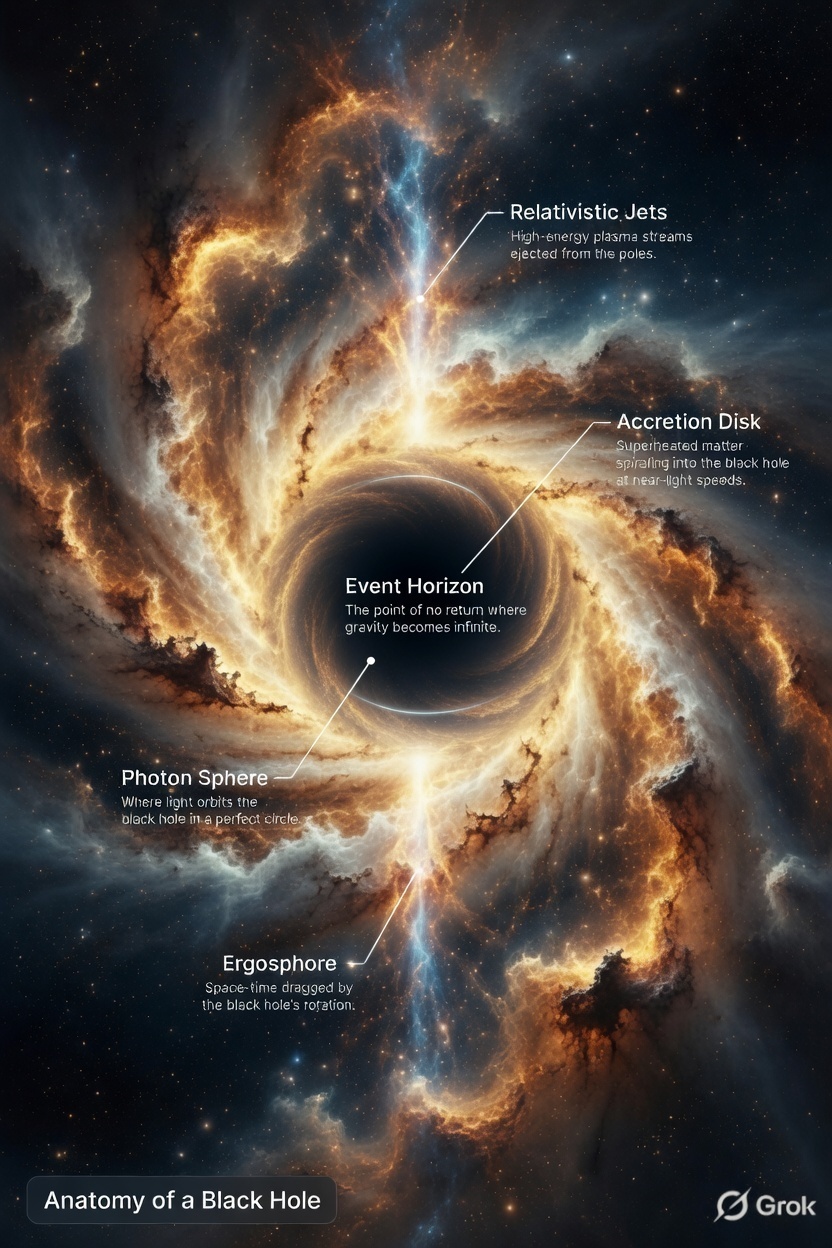
Important Parts of a Black Hole
Event Horizon : The boundary where escape velocity exceeds the speed of light.
Singularity : The infinitely dense center of the black hole.
Accretion Disk : A rotating disk of gas, dust, and matter heated to extremely high temperatures before falling into the black hole.
Relativistic Jets : Powerful beams of particles sometimes emitted from regions near black holes.